
Thicker is not always better. Here is what pile height and total thickness mean, the ranges mosque carpets usually fall in, and what to ask a supplier.
"How thick is it?" is one of the first questions committees ask about a mosque carpet — and one of the easiest to get wrong. Thickness matters for comfort during prostration, but on its own it says little about how long a carpet will last. Here is what the numbers mean.
Pile height and total thickness are different
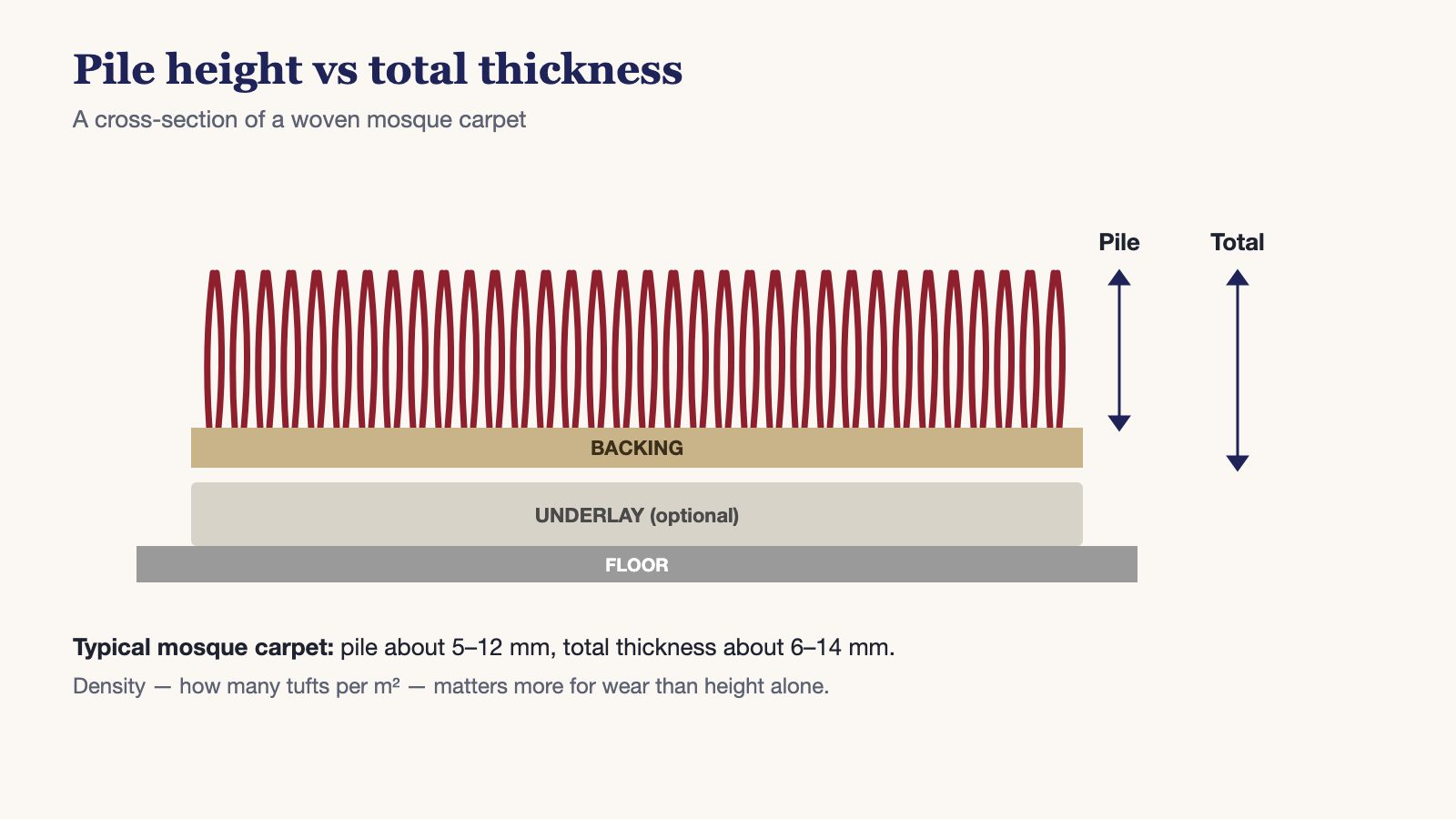
- Pile height is the height of the yarn above the backing — the part you feel under your forehead and knees.
- Total thickness is the pile plus the backing. It is what a supplier measures when quoting a thickness to a standard such as ISO 1765.
Underlay is separate again: an optional layer laid under the carpet for comfort and insulation.
Typical figures for mosque carpet
There is no single standard, but published specifications from mosque carpet suppliers cluster in a fairly narrow band:
- Total thickness: about 6–14 mm, with heavy-duty mosque carpet commonly around 9–12 mm.
- Pile height: about 5–12 mm.
One acoustic study of masjid carpets measured pile heights of about 10.5–12 mm for acrylic, 9.5–10.5 mm for polypropylene and 8.5 mm for a wool carpet — a reminder that fibres are woven to different heights for the same job.
Why density matters more than height
A tall pile with few tufts crushes quickly, shows every footprint and can feel unsteady when you stand up from prostration. A medium pile packed densely springs back, stays even and lasts for years. That is why two carpets of the same thickness can wear completely differently. When comparing quotes, ask for the pile weight or total weight per m² alongside the thickness.
Comfort without a deep pile
If the congregation includes many elderly worshippers, or the floor is cold stone or concrete, comfort is better added with underlay than with a deeper pile. Underlay cushions the knees, insulates against a cold floor and spreads the load, which also helps the carpet last. Over underfloor heating, choose a thin, heat-conductive underlay — or none — so the warmth still reaches the room.
Thickness and fibre
Wool's natural springiness lets it feel comfortable at a slightly lower pile; acrylic is often woven a little higher to give the same softness. See wool mosque carpet and acrylic mosque carpet for how each performs.
What to ask a supplier
- Pile height and total thickness, and the standard they are measured to.
- Pile weight or total weight per m².
- Whether underlay is recommended for your floor, and its thickness.
Frequently asked questions
How thick should a mosque carpet be?
Most mosque carpet falls between about 6 and 14 mm in total thickness, with a pile of about 5–12 mm. A medium, dense pile usually beats a very deep one.
Is thicker mosque carpet more comfortable?
Up to a point. Beyond a medium pile, extra height adds instability rather than comfort; underlay is the better way to add cushioning.
Does mosque carpet need underlay?
Not always, but it helps on cold, hard or uneven floors and extends the carpet's life. Use a thin one over underfloor heating.
Ready to compare options? Read our checklist for choosing a mosque carpet and the installation guide.